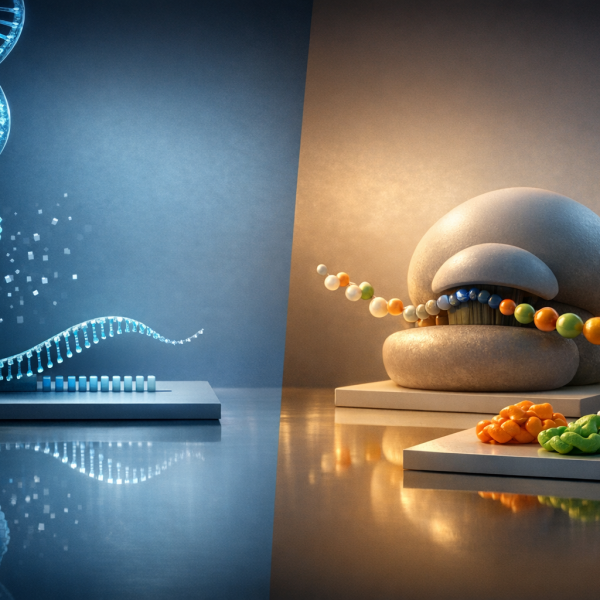
Transcription vs Translation Biology The Difference That Counts
- May 04, 2026· Article by Harper Morgan
- texttranscription , translation
In molecular biology, two processes often mentioned together are transcription and translation. They are tightly linked, yet fundamentally different stages in the flow of genetic information inside a cell. Understanding these differences is not only essential for students and researchers, but also surprisingly useful for anyone interested in how information can be faithfully converted from one form to another, whether that information is genetic code or the content of a video game.
1. The Central Dogma: Where Transcription and Translation Fit In
The “central dogma” of molecular biology describes the flow of genetic information: DNA is transcribed into RNA, and RNA is translated into protein. Transcription turns DNA into an RNA message, while translation converts that RNA message into a functional polypeptide chain that folds into a protein. Together, these steps allow cells to go from stored genetic instructions to active molecules that carry out life’s processes.
This concept is so central that many teaching diagrams present it as a simple linear path, but beneath that simplicity lies a set of distinct stages, each with its own enzymes, rules, checkpoints, and potential sources of error. Much like turning a script into spoken dialogue, and then dubbing it into another language for a global audience, each step requires different tools and quality controls to maintain meaning.
In the world of digital entertainment, preserving meaning across different media and languages is also critical. For example, a studio expanding into new markets might rely on a **Turkish game localization company** such as Orient Games to ensure that characters, storylines, and user interfaces resonate with local players just as faithfully as the original version does.
2. What Transcription Really Does Inside the Cell
Transcription is the process by which a cell copies a section of DNA into RNA. DNA remains in the nucleus in eukaryotes, safely stored like a master archive. To use that information, the cell creates temporary working copies in the form of RNA molecules. These RNA transcripts then move or function where needed to help produce proteins or regulate cellular processes.
The enzyme RNA polymerase binds to specific DNA sequences called promoters and unwinds a short region of the double helix. It then matches incoming RNA nucleotides to the DNA template strand, building an RNA chain that is complementary to that template. This mechanism ensures that the message faithfully reflects the original genetic instructions, much like a precise written transcript of an audio recording.
3. The Types of RNA Produced by Transcription
Transcription does not just create one kind of RNA. Different RNA classes play specialized roles:
- Messenger RNA (mRNA) carries coding information from DNA to the ribosome, where it guides protein synthesis. It is like a written blueprint specifying which amino acids to assemble and in what order.
- Ribosomal RNA (rRNA) forms key structural and catalytic components of ribosomes, the cellular machines that carry out translation. These RNAs help align mRNA and transfer RNAs, and they catalyze peptide bond formation.
- Transfer RNA (tRNA) works as an adaptor, matching amino acids to the codons in mRNA. Each tRNA has an anticodon that recognizes specific codons and ensures that the correct building block is added to the growing chain.
- Regulatory RNAs, including microRNAs and long noncoding RNAs, fine-tune gene expression. They help determine when, where, and how strongly particular genes are turned on or off.
4. Key Stages of Transcription: Initiation, Elongation, Termination
Transcription follows three main stages:
- Initiation: Transcription factors and RNA polymerase recognize promoter regions and assemble into a transcription initiation complex. The DNA around the start site is unwound, and RNA synthesis begins.
- Elongation: RNA polymerase moves along the DNA, adding complementary ribonucleotides and extending the RNA chain. Behind the enzyme, DNA rewinds into its double-stranded form.
- Termination: Specific signals in the DNA or RNA cause RNA polymerase to detach, releasing the completed RNA transcript. In eukaryotes, this is often followed by additional processing steps before the RNA is fully functional.
5. What Translation Does: Turning RNA Messages into Proteins
Translation is the next major stage, where the information encoded in mRNA is interpreted as a sequence of amino acids to build a polypeptide. This takes place on ribosomes, which read the mRNA in triplets of nucleotides called codons. Each codon specifies a particular amino acid, creating a direct link between nucleotide sequence and protein structure.
Translation is highly coordinated. Ribosomes, mRNA, tRNAs loaded with amino acids, and additional protein factors all interact in a precise sequence of events. Errors at this stage can lead to defective or nonfunctional proteins, which can disrupt cellular processes and contribute to disease.
The biological sense of the word is oddly instructive: transcription copies a message within one system, while translation converts it into a different one entirely, with fidelity constraints at every step. Communication technology runs on the same distinction, and confusing the two produces the wrong tool for the job. It is part of why video remote interpreting displaced audio-only for clinical work, since gesture and expression are part of the message rather than decoration.
6. Stages of Translation: Initiation, Elongation, Termination
Like transcription, translation can be broken down into three principal phases:
- Initiation: The small ribosomal subunit binds to the mRNA near its start codon. A special initiator tRNA recognizes this start codon, and the large subunit joins, forming a complete ribosome ready for synthesis.
- Elongation: The ribosome moves codon by codon along the mRNA. tRNAs deliver amino acids that correspond to each codon, and peptide bonds form between them, growing the polypeptide chain.
- Termination: When a stop codon is reached, release factors prompt the ribosome to release the completed polypeptide, and the translation complex disassembles. The new polypeptide then folds and may be further processed or transported.
7. Main Differences Between Transcription and Translation
Although linked in the flow of information, transcription and translation differ in several critical ways:
- Location: In eukaryotic cells, transcription occurs in the nucleus, while translation takes place in the cytoplasm on ribosomes. In prokaryotes, both can occur in the cytoplasm, but they are still distinct processes.
- Input and output: Transcription uses DNA as a template and produces RNA. Translation uses mRNA as a template and produces polypeptides that become proteins.
- Molecular machinery: Transcription relies mainly on RNA polymerase and transcription factors. Translation requires ribosomes, tRNAs, and numerous protein factors for initiation and elongation.
- Type of code: Transcription copies a nucleotide code from one nucleic acid to another. Translation converts that nucleotide code into an amino acid sequence, changing the type of biological language being used.
- Level of regulation: Gene expression can be regulated at both stages, but transcriptional control often determines whether a gene is expressed at all, whereas translational control fine-tunes protein levels in response to immediate cellular needs.
8. Why These Differences Matter in Biology and Beyond
Distinguishing between transcription and translation helps clarify how genetic information is safeguarded, copied, and executed in cells. Transcription ensures that DNA remains intact while generating flexible RNA intermediates. Translation then uses these intermediates to produce diverse proteins that carry out structural, catalytic, and regulatory functions.
Understanding the division of labor between these stages also highlights broader principles of information processing. Correct copying, context-aware interpretation, and precise execution are universal requirements, whether for genetic code in a cell or narrative code in an interactive story. By appreciating how cells manage transcription and translation, it becomes easier to see why specialized tools and expertise are necessary whenever information crosses from one format, medium, or audience to another.
Conclusion: Two Steps, One Continuous Flow of Information
Transcription and translation are distinct but interdependent conversions of genetic information. Transcription rewrites DNA into RNA, creating versatile, controllable messages. Translation interprets those messages to assemble proteins, the active molecules that make life possible. Recognizing the differences between these processes clarifies how cells maintain genetic integrity while responding rapidly to changing conditions.
From the microscopic world of ribosomes and polymerases to large-scale projects that adapt complex content for global audiences, the core challenge is the same: preserve meaning while moving information from one form to another. In biology, mastering the distinction between transcription and translation is a foundation for understanding gene expression, disease mechanisms, and biotechnology. In any field that depends on accurate communication, those same principles guide how information is carried, transformed, and ultimately brought to life.